In March 2026 I built a 19-agent development team running entirely inside Claude Code. Not as a toy. As a production tool for building my own SaaS products. Here's the honest breakdown: what works, what doesn't, what it costs, and when it actually makes sense.
Why 19 agents instead of one Claude
One Claude instance tries to do everything at once and does none of it well. Ask it to "build a Stripe payment endpoint": you get the backend, but schema validation is missing. Add "with tests": tests appear but don't cover edge cases. "And make it secure": a patch shows up, but DevOps never configured staging environment variables.
The root problem is lack of separation of concerns. One model has too much context, too many priorities, too little specialization. The fix is the same as in real companies: specialists with narrow ownership + a PM who coordinates.
That's how Dev Team v3.1 was born: 19 agents across 4 layers, a 10-phase pipeline, all contained in ~/.claude/skills/team-dev/SKILL.md.
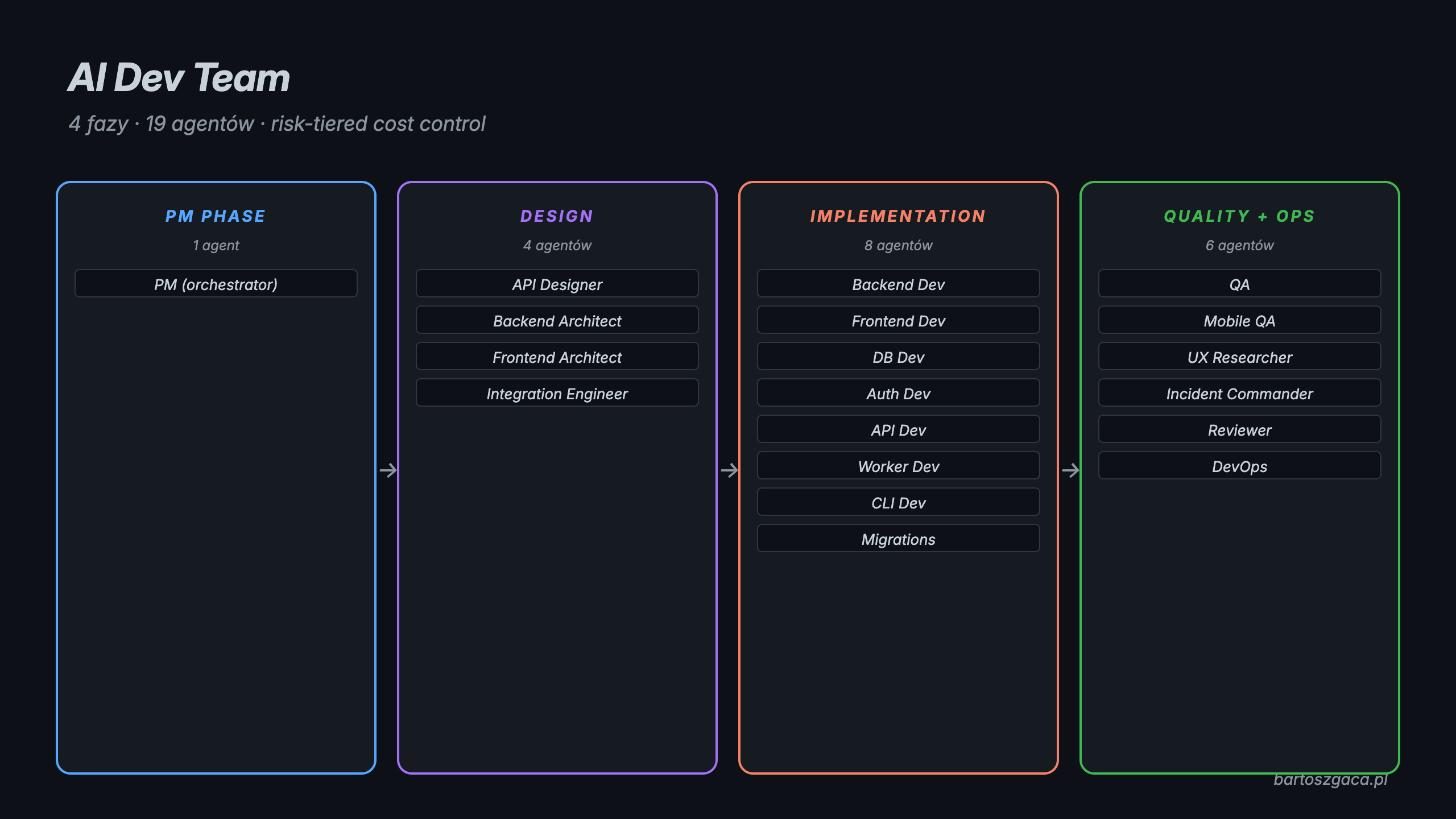
Architecture: 4 layers, 19 agents
Layer 1: Design & Architecture
API Designer: designs API contracts before anyone writes a line of code. Detects breaking changes, versions endpoints, generates OpenAPI spec. First in, first out: output becomes input for Layer 2.
Layer 2: Core Development (4 agents)
- PM (orchestrator): coordinates everyone, owns
board.jsonwith task status, writes zero code - Backend: Node.js/Express, database, cache, queues
- Frontend: React/Vite, i18n, state management
- Integration Engineer: Stripe, external APIs, MCP connections, webhooks
Layer 3: Quality & Security (9 agents)
Code Reviewer, Database Admin, Security Engineer, Tester (Playwright E2E), Mobile QA, UX Researcher, Performance, Billing/Compliance, Incident Commander. Each has a narrow mandate and cannot override another agent's domain.
Layer 4: Delivery & Operations (5 agents)
DevOps, SEO, Release Manager, Documentation Writer, Data/Analytics Engineer. These run after the feature is built. Release Manager owns the go/no-go decision.
10-phase pipeline in practice
| Phase | Agents | Goal |
|---|---|---|
| 0 | API Designer | Contract design before code |
| A | Backend + Frontend | Parallel implementation |
| B | Code Reviewer + DBA | Code review + DB migrations |
| B.5 | all | Staging validation |
| C | Security + Perf + UX + Mobile + Billing | Parallel audits |
| C.5 | Release Manager | Deployment readiness gate |
| D | Tester | Full E2E testing |
| D.5 | DevOps | Post-deploy smoke tests |
| E | SEO + DevOps + Docs + Analytics | Post-launch operations |
| E.5 | Release Manager | Release notes + runbooks + monitoring |
Risk-based shortcuts:
- LOW risk (copy fix, color change): A → B → D → deploy
- MEDIUM risk (new endpoint, new page): 0 → A → B → C → D → E → deploy
- HIGH risk (payment changes, DB migrations): all 10 phases
- HOTFIX: A → B → D → deploy → audit next day
Case study: reklamacje24.pl built with team-dev
In February 2026 I built reklamacje24.pl, a SaaS for generating Polish legal complaint letters. First version (landing + payment + letter generation) took 4 developer-days:
- Day 1: API Designer → Backend (Express + PostgreSQL schema)
- Day 2: Frontend (React + Vite) + Integration Engineer (Stripe Checkout + webhooks + BLIK/P24)
- Day 3: Security Engineer (CSP headers, input validation, SQLi scan) + Tester (Playwright E2E)
- Day 4: DevOps (Docker + GitHub Actions CI/CD) + SEO (schema.org, sitemap)
Without team-dev: my honest estimate is 2-3 weeks for the same result. Not because Claude writes faster, but because fewer things get forgotten. Security Engineer will catch what I'd skip after 8 hours of coding. DBA will always check if the migration has a rollback.
What genuinely doesn't work
Long context degrades after 4-5 phases. The PM loses the thread, starts repeating tasks or skipping steps. Fix: context reset after Phase C, manually feed board.json with current state.
Agents write conflicting things. Backend builds POST /api/v1/complaints, Frontend calls /api/complaints. This is normal without API Designer as the blocker. The API Designer phase is not optional.
Token cost scales with risk level. A full 10-phase pipeline on a complex feature (Stripe + BLIK + P24 with error handling) easily hits 500K-1M tokens. That's $15-30 per feature with Opus 4. Justified for payment logic, not for footer text changes.
Setup
The skill lives in ~/.claude/skills/team-dev/SKILL.md. Invoke with /team-dev describe what you want to build. Claude adopts the PM role and spawns subsequent agents via the built-in Agent() tool with isolated context per agent.
No external tools needed: works with standard Claude Code CLI. The only dependency is an active Claude Max subscription or an API key with Opus/Sonnet access.
Want to apply this?
If you're building your own product and want to compress development time through a multi-agent setup in Claude Code, I can show you how to configure the pipeline for your stack. Check my services or Book a free call (30 min).