I run a portfolio of my own projects: SaaS products, SEO sites, automation tools. The question "what to develop next, what to trim, how to monetize" used to take me hours every week and relied on gut feeling more than data. So I built a 6-agent strategic advisory board in Claude Code, an AI equivalent of a board of advisors that meets every two weeks and recommends what to do next. It does not make decisions. I do. But it gathers data, analyzes it, and recommends much faster than I could alone.
The problem: project portfolio × 1 brain = too many variables
Every two weeks I need to decide: which project gets the next sprint, which one to trim, where the quick win is in GSC or GA4, what price for the next service package, what dev team should build, what marketing should plan.
I did this manually for 18 months. It took too long, relied too much on my current mood, and lacked real-time data from multiple sources at once. Strat Team is my solution.
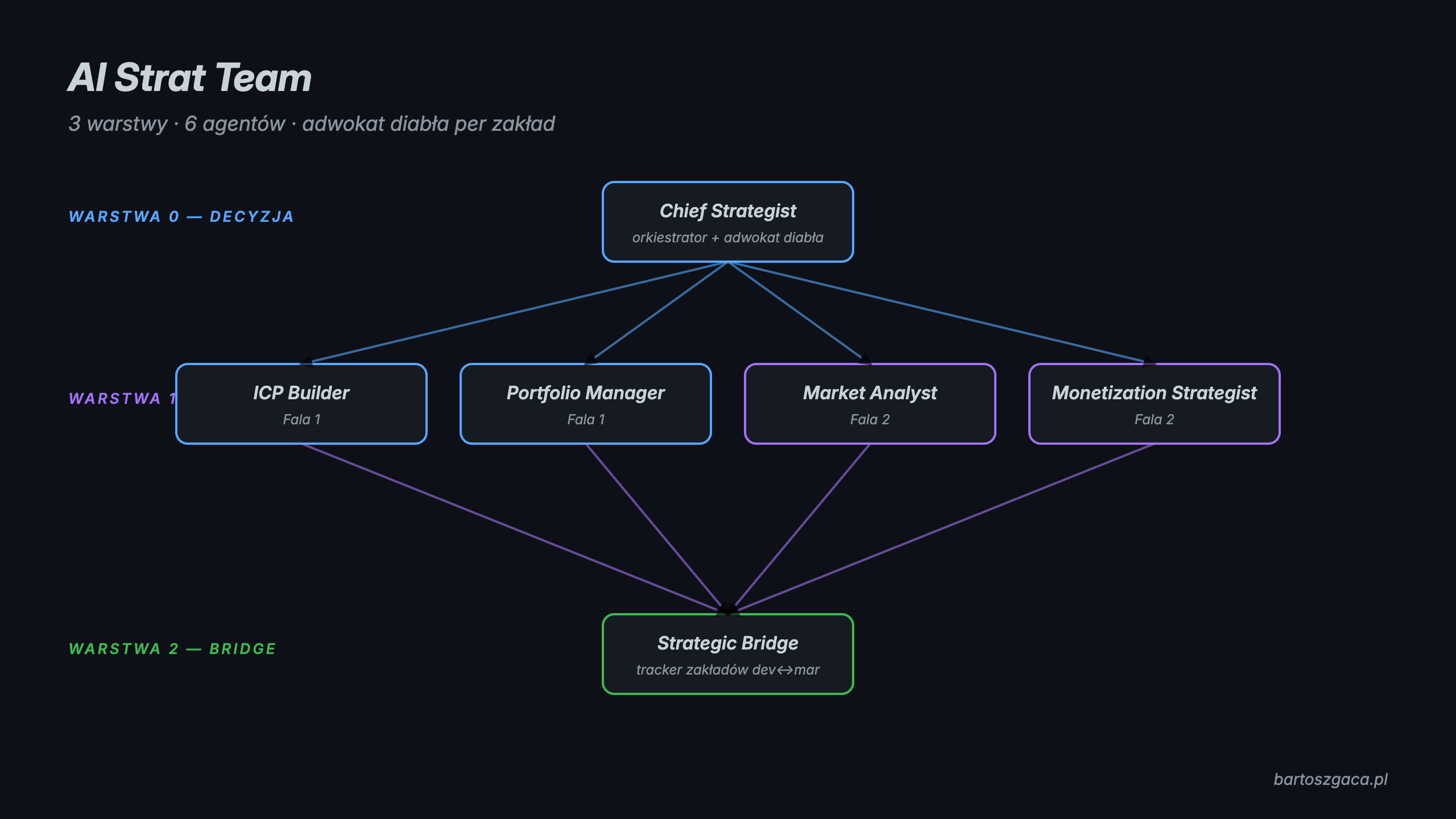
Architecture: 3 layers, 6 agents
Layer 0: Decision (1 agent)
Chief Strategist (orchestrator): runs board meetings, owns quarterly bets, plays devil's advocate per every recommendation. Before any "do this," must generate minimum 2 counter-arguments. This prevents confirmation bias.
Layer 1: Analysts (4 agents, 2 waves)
Wave 1 (parallel):
- ICP Builder: who is the buyer (language, triggers, fears per project).
- Portfolio Manager: multi-channel scorecard from web analytics, search console, paid campaigns, payment data.
Wave 2 (parallel, reads Wave 1 output):
- Market Analyst: TAM/SAM, competitors, channel-fit matrix, untapped niches.
- Monetization Strategist: pricing tiers, paywall placement, funnel design, personal-brand offerings (MVP Sprint, Builder Retainer, Automation Pack).
Layer 2: Bridge (1 agent)
Strategic Bridge: bet execution tracker. Looks at dev team and marketing team state to report how many bets from the previous quarter actually shipped. This agent closes the loop: without it, recommendations are just talk; with it, you know what works and what does not.
5-phase pipeline
| Phase | What happens |
|---|---|
| 1 | ICP Builder + Portfolio Manager (parallel): gather data |
| 2 | Market Analyst + Monetization Strategist (parallel): analyze |
| 3 | Chief Strategist: generates board report with recommendations and counter-arguments |
| 4 | Me: manual approval per recommendation (APPROVED marker) |
| 5 | Chief Strategist: briefs dev team and marketing team from approved bets |
Phase 4 is an intentional stop point. No agent executes anything without my APPROVED markers. Only after I insert them does Chief Strategist generate briefs for dev and mar teams.
What Strat Team does and does not
| Does | Does NOT |
|---|---|
| Pulls data from its sources | Does not modify any production data |
| Generates a board meeting report every 2 weeks | Does not publish anything without my approval |
| Recommends bets per project | Does not "implement" recommendations: only briefs team-dev and team-mar |
| Plays devil's advocate per recommendation | Does not modify code or content directly |
| Tracks execution of previous bets | Does not make decisions: I do |
Cadence
Default every two weeks (1st and 15th of each month). Ad-hoc when I need to quickly decide about a single project. There is no point running a full meeting more often. Data does not change that fast.
When is it worth it?
For 1-2 projects: no. The overhead is too high relative to the benefit. For 5+ projects running in parallel: yes. My analysis time dropped from 4-5 hours to 1 hour. Recommendation quality is higher because it pulls from more data sources than I would gather manually.
The most important change: I now have a devil's advocate for my own ideas. That is the most underrated feature, not "AI that plans" but "AI that questions" what I have already planned.
Want something similar?
I can build an equivalent system for your project portfolio, adapted to your KPIs and stack. Check my services or Book a free call (30 min).